Workplaces are moving beyond traditional screens, keyboards, and physical meeting rooms as spatial computing becomes increasingly practical for professional environments. Instead of simply displaying digital information on a flat monitor, spatial computing enables digital objects, applications, and environments to interact with physical surroundings. This shift is creating new possibilities for companies that want employees to collaborate, visualize complex information, and perform specialized tasks in more interactive ways. The development of advanced headsets, sensors, computer vision, artificial intelligence, and 3D software is helping organizations explore workspace experiences that combine physical and digital environments.
The growing interest in immersive workspaces also reflects a broader change in how businesses think about technology. Remote and hybrid work have increased demand for better digital collaboration, while industries such as engineering, healthcare, manufacturing, architecture, education, and professional services increasingly depend on three-dimensional information. Tech Hopes represents this wider technology movement toward tools that can make digital experiences more contextual and interactive. Rather than treating immersive technology as entertainment alone, businesses are examining how spatial interfaces can support practical workplace activities.
As hardware becomes more capable and software ecosystems mature, spatial computing can potentially influence everything from virtual meetings to product design. The most meaningful developments are not necessarily about creating completely virtual offices. Instead, they involve making digital information easier to understand and interact with while employees remain connected to their physical surroundings.
What Is Spatial Computing in the Modern Workplace?
Spatial computing refers to technologies that allow computers to understand and respond to physical space while presenting digital information within that environment. Cameras, depth sensors, motion tracking, artificial intelligence, augmented reality, virtual reality, and mixed reality can work together to create experiences where users interact with digital content using gestures, movement, voice, controllers, or conventional input devices. In a workplace, this can mean placing a virtual dashboard beside a physical workstation, examining a three-dimensional product model, or participating in an immersive meeting.
Unlike traditional desktop computing, spatial interfaces can provide information according to a user’s environment and position. For example, an engineer examining a virtual machine model could walk around it and inspect components from different angles rather than relying on a two-dimensional drawing. An architect could review a building concept at an interactive scale, while a maintenance technician might receive visual instructions positioned near the equipment being serviced.
Tech Hopes reflects the growing business interest in these practical applications. The technology is particularly relevant when employees need to understand spatial relationships, complex structures, or visual information that is difficult to communicate through conventional screens.
Immersive Collaboration Is Changing Teamwork
One of the most visible applications of spatial computing is collaborative work. Conventional video conferencing provides communication through cameras, microphones, and shared screens, but participants generally remain represented by rectangular windows. Immersive collaboration can introduce shared three-dimensional environments where employees interact with virtual objects and workspaces.
This approach could be useful for distributed teams that regularly review designs, prototypes, simulations, or technical information. Instead of sharing a static presentation, participants can potentially examine a three-dimensional model together, highlight individual components, and discuss changes while maintaining a stronger sense of spatial context. Such environments may also help teams communicate information that would otherwise require physical meetings or expensive travel.
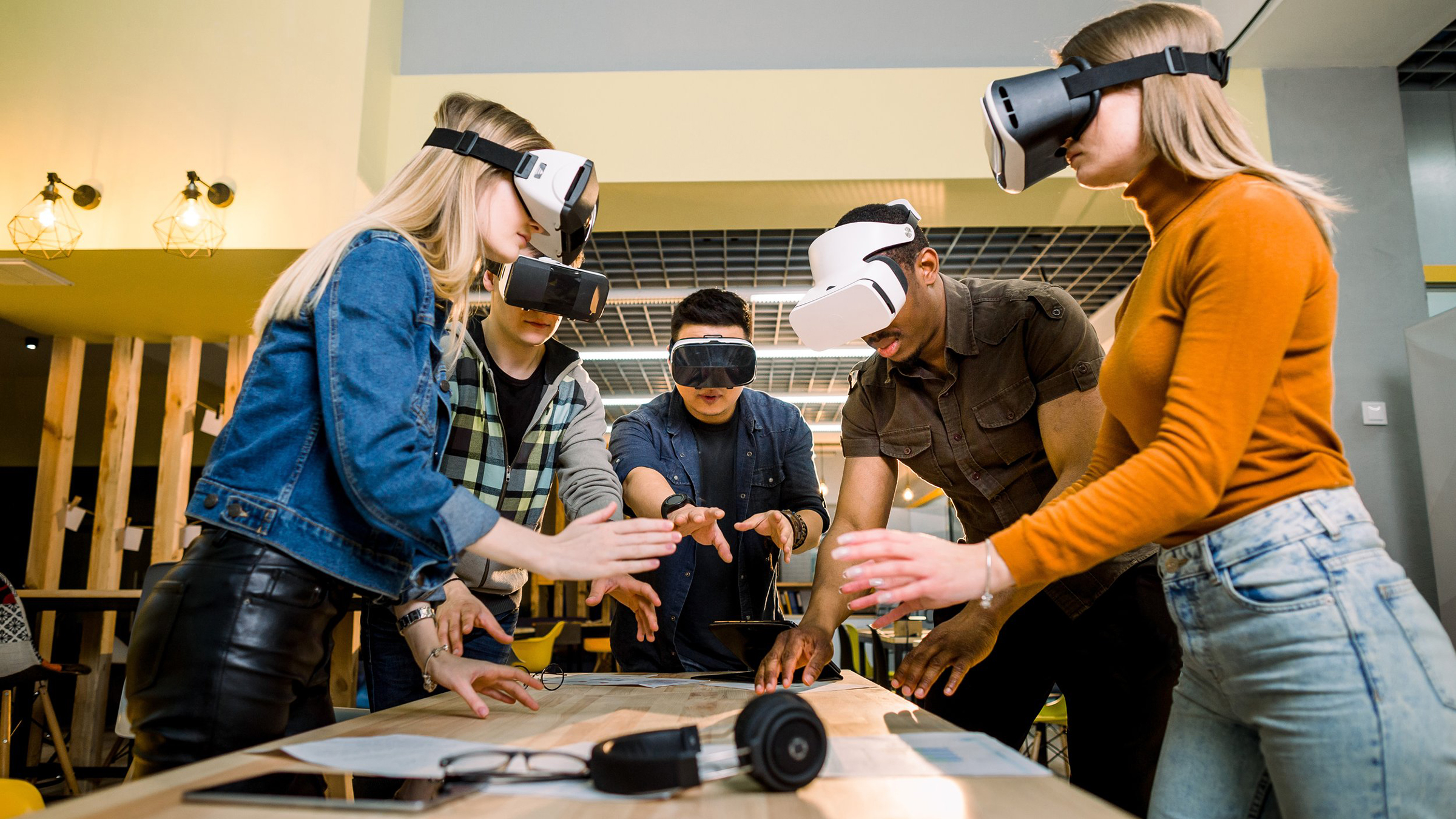
However, effective workplace adoption depends on more than visual quality. Organizations must consider headset comfort, device management, accessibility, network performance, privacy, and employee training. The strongest applications are likely to be those where immersive interaction provides a genuine advantage rather than simply replacing a familiar desktop workflow with a more complicated interface.
How Spatial Computing Supports Different Industries
Spatial computing has applications across multiple sectors because many professional tasks involve visualization, physical environments, or complex technical information. Manufacturing companies can use immersive models for product development and factory planning, while construction teams can compare digital building information with physical spaces. Healthcare organizations may explore immersive visualization for education, simulation, and selected clinical workflows.
The technology can also support retail, logistics, education, automotive development, aerospace, and energy operations. For example, a logistics company could use spatial representations to study warehouse layouts and movement patterns. An automotive design team could inspect virtual vehicle concepts before producing physical prototypes. These applications can help organizations identify potential design issues earlier in a project and make complicated information easier for teams to interpret.
| Industry | Potential Spatial Computing Application | Workplace Value |
|---|---|---|
| Manufacturing | 3D product visualization | Faster design review |
| Healthcare | Training and simulation | Immersive learning |
| Architecture | Building visualization | Better spatial understanding |
| Education | Interactive environments | More engaging instruction |
| Logistics | Facility planning | Improved workflow analysis |
The important point is that spatial computing does not provide the same value to every organization. Tech Hopes highlights an emerging technology direction in which businesses can select applications according to their operational needs rather than adopting immersive tools simply because they are technologically impressive.
AI and Spatial Computing Are Becoming Closely Connected
Artificial intelligence can significantly expand what spatial computing systems are capable of doing. Modern AI models can help systems recognize objects, interpret environments, understand natural language, summarize information, and respond to user instructions. When these capabilities are combined with spatial awareness, workplace interfaces can become more responsive and context-sensitive.
Imagine a technician wearing an immersive device while inspecting industrial equipment. Instead of manually searching through documentation, the worker could ask a voice-based assistant for information about a specific component. The system could potentially identify the equipment through cameras, display relevant instructions, and provide contextual information based on the worker’s location.
AI can also help transform large amounts of workplace data into more understandable visual experiences. Business intelligence dashboards, for instance, could evolve beyond conventional charts by presenting information in interactive spatial environments. Tech Hopes can be viewed within this broader convergence of AI, immersive interfaces, automation, and connected workplace systems.
Virtual Training Can Reduce the Limits of Traditional Learning
Employee training is another area where immersive workspaces can provide practical benefits. Traditional training often relies on presentations, manuals, videos, or supervised demonstrations. These methods remain useful, but they may not fully replicate environments where employees need to make decisions or respond to physical situations.
Spatial computing allows organizations to create simulated environments where employees can practice specific procedures. A manufacturing worker could learn equipment operation within a simulated factory environment, while an emergency response team could rehearse procedures without exposing participants to real-world hazards. Employees can repeat scenarios and receive feedback without requiring the physical resources associated with every training exercise.
This makes immersive learning particularly interesting for organizations with expensive equipment, complex procedures, or safety-sensitive operations. Tech Hopes connects with this changing training landscape by emphasizing how emerging technology can move digital learning from passive consumption toward interactive experiences.
Spatial Workspaces Can Improve Data Visualization
Modern organizations generate enormous volumes of information, and understanding that data can become difficult when everything is confined to spreadsheets and dashboards. Spatial computing provides another method of presenting information by allowing users to examine data in three-dimensional or immersive formats.

For example, an urban planning team could visualize traffic patterns across a digital representation of a city. A factory manager could examine production activity across different areas of a facility. An engineering team could connect operational information to a virtual model of machinery and investigate relationships between components.
The value of this approach depends on thoughtful information design. Simply converting a conventional dashboard into a three-dimensional environment does not automatically make it easier to understand. Organizations need interfaces that reduce complexity and help employees focus on relevant information. This is where the combination of spatial design, AI, analytics, and user-centered software development becomes important.
Challenges Facing Immersive Workplace Adoption
Despite its potential, spatial computing still faces several challenges. Hardware costs, employee acceptance, device comfort, cybersecurity, privacy, software compatibility, and technical support can all influence whether an organization achieves meaningful results. Businesses also need to determine whether immersive solutions integrate effectively with existing systems rather than creating isolated technology environments.
There are several practical concerns organizations should evaluate before expanding spatial computing programs:
- Hardware availability, comfort, and maintenance requirements.
- Integration with existing workplace software and data systems.
- Employee training, accessibility, and user acceptance.
- Security, privacy, and management of spatial data.
- Long-term costs compared with measurable business benefits.
Privacy deserves particular attention because spatial devices can potentially collect information about rooms, surroundings, movements, voices, and interactions. Businesses need clear policies governing what information is collected, why it is collected, where it is stored, and who can access it.
The Future of Immersive Workspaces
The future of spatial computing is likely to involve a combination of physical and digital environments rather than a complete replacement of conventional offices. Employees may continue using laptops and smartphones while occasionally switching to spatial interfaces for activities where immersive visualization provides a clear advantage. This blended model could make technology more practical because workers can choose the interface that best fits a particular task.
Future systems may also become less dependent on specialized hardware as sensors, AI processing, displays, and spatial mapping technologies improve. More natural interaction through voice, gestures, eye tracking, and context-aware software could reduce the learning curve associated with immersive applications. The result could be work environments where digital information appears when it is useful and disappears when it becomes unnecessary.
Tech Hopes fits into this larger transformation because the future workplace is increasingly being shaped by interconnected technologies rather than isolated innovations. Spatial computing, AI, cloud platforms, automation, and advanced collaboration tools are gradually converging into broader digital ecosystems.
Conclusion
Spatial computing is transforming the concept of the workplace by creating new ways to interact with digital information and physical environments. Its potential extends across collaboration, training, design, engineering, data visualization, healthcare, manufacturing, education, and many other professional areas. Rather than focusing only on virtual offices, businesses are increasingly examining practical situations where spatial interfaces can improve understanding, communication, and workflow efficiency. The next stage of development will depend on affordability, usability, security, interoperability, and measurable workplace value. Organizations that evaluate immersive technologies according to real business requirements can better identify where spatial computing fits into their operations. As AI and spatial awareness become increasingly connected, Tech Hopes reflects the broader movement toward workplaces where digital information is more interactive, contextual, and closely integrated with the physical world.