
Agriculture is entering a technology-driven period in which data, automation, artificial intelligence, connected devices, and advanced machinery are changing how crops are grown and managed. Traditional farming still plays an essential role, but farmers increasingly have access to tools that can provide detailed information about soil conditions, crop health, irrigation requirements, weather patterns, and field productivity. These technologies allow agricultural decisions to become more precise rather than relying entirely on visual inspection or historical assumptions.
The growing use of smart agriculture is particularly important as farmers face changing weather conditions, water limitations, rising input costs, labor challenges, and increasing demand for food production. Instead of applying the same treatment across an entire field, precision technologies can help identify areas that require specific attention. Tech Hopes reflects the broader expectation that technology can make agricultural operations more efficient while helping farmers manage resources more carefully.
Modern agricultural technology is no longer limited to large automated machines. Smartphones, satellite imagery, connected sensors, drones, artificial intelligence systems, GPS equipment, and cloud-based platforms are becoming part of agricultural workflows. When these technologies are combined effectively, they can create a more connected farming environment where farmers receive useful information before making important crop-management decisions.
How Smart Agriculture Is Changing Crop Management
Smart agriculture combines digital technology with farming practices to collect information and support better operational decisions. Sensors placed in fields can monitor soil moisture, temperature, humidity, nutrient conditions, and other environmental factors. This information can be transferred to digital platforms where farmers can examine field conditions without physically checking every section of a large farm.
One of the most important changes is the movement from generalized farming toward precision management. In conventional farming, a farmer may irrigate or fertilize an entire field according to a broad schedule. Smart agriculture can identify differences between areas within the same field. A dry section may require additional irrigation while another area may already contain sufficient moisture. This targeted approach can reduce unnecessary resource use and provide crops with conditions better suited to their growth stages.
Tech Hopes in agriculture therefore involves more than simply introducing advanced equipment. The real value comes from connecting technologies so that information can support practical decisions. For example, weather information can be combined with soil-moisture data to help determine when irrigation should take place. Similarly, crop imagery can identify areas showing signs of stress before the problem becomes obvious across the entire field.
Precision Agriculture and Data-Based Decisions
Precision agriculture is one of the strongest examples of technology changing modern crop management. GPS-enabled equipment allows farmers to map fields accurately and track activities such as planting, spraying, harvesting, and soil treatment. Digital field maps can show differences in crop performance and help farmers understand where improvements may be required.
Data collection also allows agricultural operations to become more measurable. Farmers can compare yield information from different areas of a field and examine how factors such as soil characteristics, irrigation, fertilizer application, and weather affected results. Over several growing seasons, this information can help establish patterns that would be difficult to recognize through observation alone.
Artificial intelligence can add another layer of analysis by processing large quantities of agricultural information. AI systems can examine images, weather records, sensor readings, and historical data to identify potential crop problems or provide predictions. These systems are not a replacement for agricultural expertise, but they can give farmers additional information when evaluating complex situations.
AI-Based Crop Monitoring
AI-powered crop monitoring is becoming increasingly useful because agricultural fields can change rapidly. Computer vision systems can analyze photographs or images captured by drones and other devices to identify differences in plant growth, discoloration, pest damage, or signs of stress. Earlier detection can give farmers more time to investigate the cause and determine an appropriate response.
The technology can also support yield estimation. Instead of waiting until harvest to understand crop performance, farmers can use field data and imagery to develop estimates during the growing season. These estimates can assist with planning labor, storage, transportation, and other agricultural requirements.
Smart Irrigation and Water Management
Water management is one of the most important applications of smart agriculture. Irrigation systems equipped with sensors can measure soil moisture and determine whether plants actually need additional water. This approach can reduce unnecessary irrigation, particularly when weather conditions or soil characteristics vary across a field.
Automated irrigation can also respond to changing conditions. If sensors indicate that soil moisture has reached an appropriate level, irrigation can be reduced or delayed. Weather information can provide additional context by indicating whether rainfall is expected. Combining these sources of information can make irrigation more responsive than a fixed schedule.
| Smart technology | Crop-management application | Potential benefit |
|---|---|---|
| Soil sensors | Monitoring moisture and soil conditions | More precise irrigation decisions |
| Drones | Field and crop monitoring | Faster identification of crop stress |
| AI systems | Data analysis and prediction | Better decision support |
| GPS machinery | Field mapping and operations | Greater operational precision |
| Weather platforms | Weather and climate monitoring | Improved planning |
| Automated irrigation | Controlled water delivery | More efficient water management |
The expansion of smart water-management systems demonstrates how Tech Hopes can translate into practical agricultural applications. Farmers do not necessarily need to automate every operation. Even a relatively simple sensor-based irrigation system can provide useful information and help improve how water is managed.
Drones and Remote Crop Monitoring
Agricultural drones provide farmers with another way to examine large areas quickly. Equipped with cameras and specialized sensors, drones can capture detailed images of fields and reveal differences that may not be immediately visible from ground level. This can be especially useful on large farms where manually inspecting every section requires significant time.
Drones can support crop scouting, plant-health monitoring, irrigation assessment, and field mapping. Their value increases when drone imagery is combined with software capable of analyzing images. Instead of simply producing photographs, the system can help identify areas that deserve closer examination.
Remote monitoring is also becoming increasingly relevant as farms adopt satellite-based agricultural services. Satellite imagery can provide repeated observations across broad geographical areas, allowing farmers and agricultural organizations to monitor crop development and environmental changes over time.
Automation and Agricultural Machinery
Labor availability and operating costs remain important considerations for many agricultural businesses. Automation can help address some repetitive tasks through machines capable of performing operations with limited human intervention. GPS-guided tractors, automated planting equipment, robotic systems, and precision spraying technologies are examples of how machinery is becoming more intelligent.
Modern agricultural machines can collect operational data while performing physical tasks. This creates an important connection between equipment and farm-management software. A tractor, for example, may record field coverage, fuel consumption, application rates, and operating routes. Such information can later be analyzed to identify opportunities for improving efficiency.
Automation does not necessarily mean eliminating human involvement. In many cases, the role of the farmer shifts toward monitoring systems, interpreting information, maintaining equipment, and making higher-level decisions. Agricultural knowledge remains essential because technology can provide information without automatically understanding every biological or environmental factor affecting a crop.
Connected Sensors and the Internet of Things
The Internet of Things is creating more connected agricultural environments. Sensors can collect information continuously and transmit it to digital systems for analysis. Soil sensors, weather stations, livestock monitors, equipment trackers, and irrigation controllers can all become components of a connected farm.
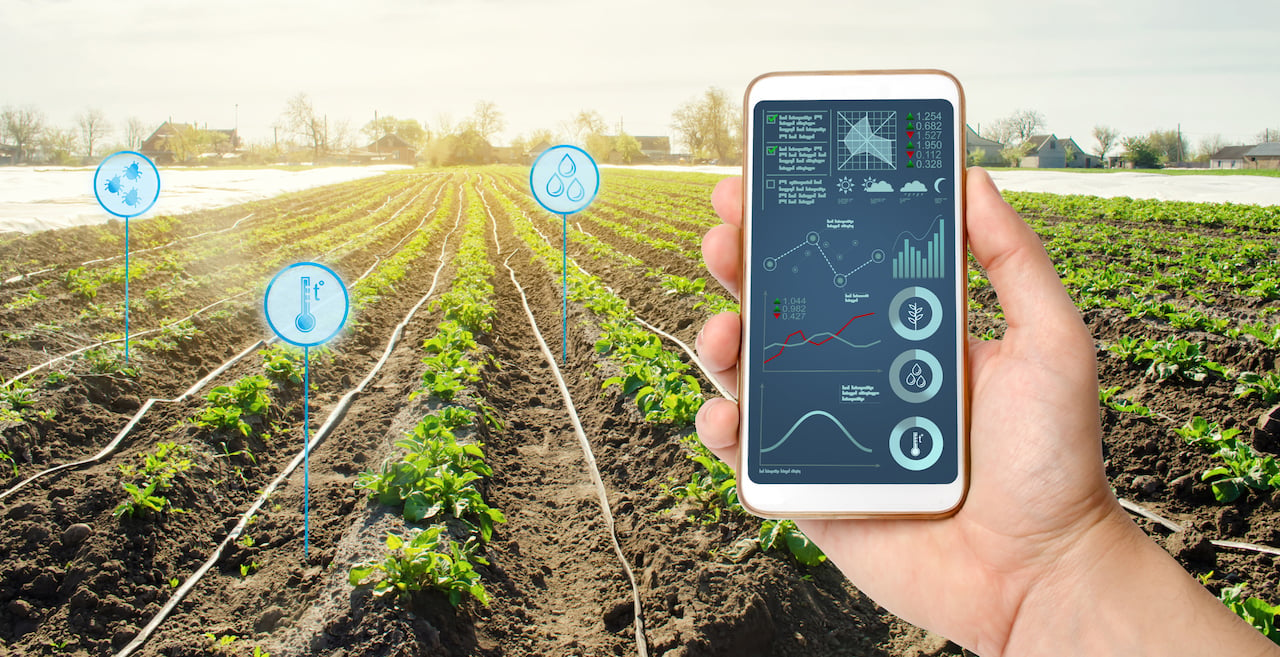
This connectivity can improve visibility. Instead of relying on occasional manual measurements, farmers may receive regular updates about field conditions. When unusual readings appear, they can investigate the affected area more quickly. Such systems can be particularly useful when farms are geographically large or when environmental conditions change rapidly.
However, connected agriculture also requires reliable infrastructure. Internet connectivity, sensor maintenance, battery life, data security, and equipment compatibility can affect how effectively these technologies operate. Farmers need systems that are practical in real agricultural environments rather than technologies that are impressive only in demonstrations.
Challenges in Adopting Smart Agriculture
Despite its potential, smart agriculture faces several challenges. The initial cost of advanced machinery, sensors, drones, software, and connectivity can be difficult for smaller agricultural operations. Farmers also need training to interpret digital information and understand whether a technology is producing genuinely useful results.
Another challenge is data management. A connected farm can generate substantial quantities of information, but collecting data is only the beginning. Farmers need systems that turn raw information into understandable recommendations. Poor-quality sensors, incorrect measurements, incompatible platforms, or confusing interfaces can reduce the practical value of otherwise advanced technology.
Some important considerations include:
- Technology costs and return on investment
- Reliable connectivity in rural areas
- Training and technical support
- Data security and ownership
- Compatibility between agricultural systems
These challenges mean that smart agriculture needs to develop around practical farming requirements. Tech Hopes becomes most meaningful when technology is affordable, accessible, reliable, and capable of solving real agricultural problems.
The Role of Technology in Sustainable Farming
Smart agriculture can contribute to more efficient resource management by helping farmers apply water, fertilizers, pesticides, fuel, and other inputs more precisely. Precision application can potentially reduce unnecessary use while maintaining appropriate conditions for crops. This can support agricultural productivity while also addressing environmental concerns.
Technology can also help farmers respond to changing weather patterns. Weather monitoring systems and predictive tools can provide information about temperature, rainfall, wind, and other conditions. Farmers can use this information when planning planting, irrigation, spraying, and harvesting activities.
Sustainability, however, should not be viewed as an automatic result of technology adoption. The environmental outcome depends on how tools are implemented and how farmers respond to the information they provide. Good agricultural practices, local knowledge, responsible resource management, and appropriate technology need to work together.
What the Future of Smart Agriculture May Look Like
The future of crop management is likely to involve increasingly connected agricultural systems. Artificial intelligence, robotics, sensors, satellite imagery, autonomous machinery, and digital farm platforms are expected to become more integrated. Instead of using separate tools for individual tasks, farmers may increasingly manage operations through connected platforms that combine multiple data sources.
AI could become particularly useful for analyzing complex agricultural information. Future systems may provide more detailed insights into crop stress, disease risks, irrigation requirements, yield expectations, and operational efficiency. Robotics may also expand in areas such as harvesting, weeding, planting, and crop inspection where repetitive manual work remains challenging.
The future is unlikely to be defined by technology alone. Farmers will continue to play a central role because agricultural decisions depend on local conditions, experience, economics, weather, crop varieties, and market requirements. Technology can provide additional information and automation, but successful farming will still require human judgment.
Conclusion
Smart agriculture is changing crop management by bringing data, connectivity, automation, artificial intelligence, and precision technologies into everyday farming. Sensors can monitor field conditions, drones can provide detailed crop imagery, GPS machinery can improve operational accuracy, and intelligent software can help farmers analyze information. Together, these technologies can create a more responsive approach to managing crops and agricultural resources. The broader idea behind Tech Hopes is particularly relevant as agriculture searches for practical ways to address resource constraints, labor challenges, changing environmental conditions, and rising production demands. The most useful agricultural technologies will not simply be the newest or most advanced systems; they will be the solutions that farmers can realistically adopt and use to solve specific problems.

