Data centers have become one of the most important foundations of the modern digital economy. Every online search, cloud application, streaming service, artificial intelligence system, digital payment, and connected business relies on computing infrastructure operating continuously behind the scenes. As digital services expand, however, the electricity required to run servers, networking equipment, storage systems, and cooling infrastructure is becoming an increasingly important energy issue. The International Energy Agency reported that global data-center electricity consumption increased by about 17% in 2025, while electricity use from AI-focused data centers grew even faster.
This changing environment is increasing interest in green data centers designed to deliver computing capacity with lower energy consumption and reduced environmental impact. Instead of focusing only on adding more servers, operators are looking at renewable electricity, efficient cooling, optimized hardware, energy storage, smarter software, and improved facility design. Tech Hopes reflects a broader technology direction in which digital growth is increasingly connected with energy efficiency, sustainability, and responsible infrastructure development.
The challenge is becoming more significant as electricity demand continues to rise globally. The IEA expects worldwide electricity demand to grow by about 3.6% annually from 2026 through 2030, with data centers among the important sources of additional demand. Green infrastructure therefore has an increasingly practical role: helping digital services expand without allowing unnecessary energy consumption to grow at the same pace.
Why Data Centers Are Becoming an Energy Priority
Traditional data centers can consume substantial amounts of electricity because they must operate around the clock. Computing equipment requires continuous power, while cooling systems remove the heat produced by processors and other electronic components. Additional electricity is needed for networking, storage, power conversion, lighting, backup systems, and facility management. When thousands of high-performance servers operate together, even relatively small efficiency improvements can create significant savings at facility scale.
The growth of artificial intelligence has made this challenge more visible. Modern AI workloads can require powerful processors and high-density server configurations that generate considerable heat. According to the IEA, electricity consumption by data centers reached approximately 485 TWh globally in 2025 and is projected to roughly double to around 950 TWh by 2030 under its central outlook. This does not mean every data center will consume energy inefficiently, but it highlights why improving the energy performance of digital infrastructure has become an important engineering priority.
For Tech Hopes, the emerging opportunity is not simply to build larger facilities. It is to make computing infrastructure smarter, more efficient, and better integrated with modern energy systems. Green data centers attempt to address this objective by considering energy consumption from the design stage rather than treating efficiency as an afterthought.
Renewable Energy Is Changing Data Center Power Strategies
One of the most visible developments in sustainable data-center infrastructure is the increasing use of renewable electricity. Solar and wind power can provide low-carbon electricity for data-center operations, either through direct generation, electricity contracts, or power-purchase arrangements. Renewable energy does not eliminate every environmental impact associated with computing, but it can reduce reliance on electricity generated from fossil fuels where suitable clean power is available.
Large technology companies and data-center operators are increasingly exploring long-term renewable-energy arrangements because data centers require predictable electricity supplies over many years. These arrangements can support new renewable generation while helping operators manage their electricity-related emissions. The IEA is also tracking the growing amount of data-center electricity demand covered through renewable power-purchase agreements, illustrating how renewable energy is becoming increasingly connected to digital infrastructure.
However, renewable power must be considered alongside reliability. A data center cannot simply stop operating when solar generation falls at night or wind production changes. This creates a need for combinations of grid electricity, renewable generation, storage, backup capacity, and sophisticated energy-management systems. The result is a more integrated approach in which computing infrastructure becomes part of a wider electricity ecosystem.
Advanced Cooling Can Reduce Hidden Energy Consumption
Cooling is one of the most important areas for improving data-center efficiency. Servers generate heat continuously, and maintaining appropriate operating temperatures is essential for reliability. Conventional cooling approaches can consume significant electricity, particularly in facilities with high computing density. As AI and other demanding workloads increase processor power requirements, managing heat becomes even more challenging.
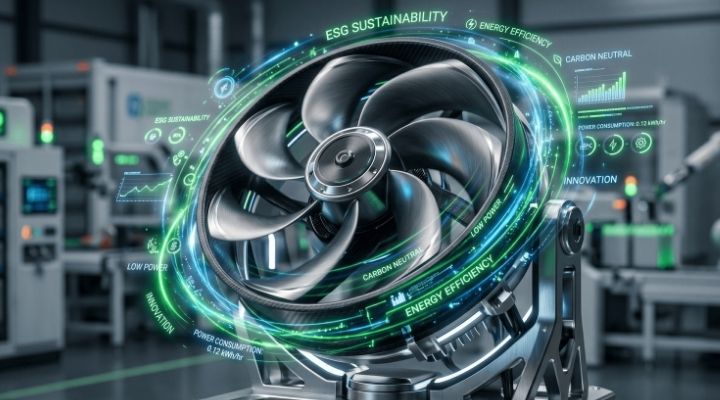
Green data centers are therefore adopting more efficient thermal-management techniques. Depending on the facility and hardware configuration, these can include advanced air cooling, liquid cooling, immersion-based approaches, free cooling, heat recovery, and intelligent temperature management. Liquid-based systems can be particularly useful for high-density computing because liquids can transfer heat more efficiently than air in many applications.
The importance of cooling is also connected to local climate conditions. A facility located in a cooler environment may have opportunities to use outside air for portions of its cooling requirements, while a facility in a hot climate may need more sophisticated thermal systems. Good green-data-center design therefore considers climate, building orientation, equipment density, water availability, and energy sources together rather than treating cooling as an isolated engineering problem.
Smarter Hardware Makes Computing More Efficient
Energy efficiency is not only a facility-level issue. The processors, memory systems, storage devices, networking equipment, and servers inside a data center also determine how much electricity is required to perform digital workloads. Modern hardware can complete substantially more computational work within a given power budget than older generations, although the overall energy impact depends on how quickly demand grows.
The IEA notes that energy consumption per AI task has been falling rapidly because of advances in software and hardware efficiency. At the same time, increasing adoption and more energy-intensive AI applications can offset some of those efficiency gains. This creates an important distinction between energy efficiency per task and total energy consumption. A system can become much more efficient while overall electricity use still rises if the number and complexity of workloads increase rapidly.
This is where Tech Hopes becomes relevant to the future of digital infrastructure. More efficient chips, accelerators, memory technologies, and networking components can reduce the electricity needed for individual workloads. When these improvements are combined with efficient cooling and intelligent workload management, the cumulative effect can be much larger than any single hardware upgrade.
The Role of Software and Artificial Intelligence
Software optimization can also influence data-center energy demand. Applications can be designed to use computing resources more efficiently, while workload scheduling can move certain tasks toward periods or locations where electricity is cleaner or less constrained. Virtualization and containerization can help organizations use available computing resources more effectively rather than leaving physical machines underutilized.
Artificial intelligence itself can also become part of the solution. Intelligent management systems can monitor temperatures, server utilization, electricity consumption, workload patterns, and equipment performance. These systems can identify inefficient operating conditions and adjust resources automatically. For example, workloads that do not require immediate completion could potentially be scheduled during periods when renewable electricity is more readily available.
At the same time, AI can increase energy demand substantially when organizations deploy increasingly complex models. The current situation therefore involves both an efficiency opportunity and an energy challenge. Tech Hopes lies in developing AI and digital systems that can deliver greater usefulness while continuously improving the efficiency of the infrastructure supporting them.
Key Green Data Center Strategies
Several approaches are increasingly being combined rather than implemented individually:
- Renewable electricity and long-term clean-energy procurement can reduce the carbon intensity of power consumption.
- Efficient cooling technologies can reduce the electricity required to manage server heat.
- High-efficiency processors and servers can deliver more computing performance per unit of energy.
- Energy-management software can monitor and optimize workloads, cooling, and power usage.
- Batteries and other flexibility technologies can help facilities manage changing electricity availability.
The strongest results generally come from combining these strategies. A facility with efficient servers but inefficient cooling may still waste energy, while renewable electricity alone does not necessarily solve excessive power consumption. Green data-center development therefore requires a systems-level approach.
Green Data Centers and Energy Storage
Energy storage is becoming increasingly relevant as data centers interact with electricity systems that contain more variable renewable generation. Batteries can provide short-duration flexibility, help manage peak demand, and support power continuity. In advanced facilities, storage can potentially work alongside renewable generation and grid services to create a more flexible energy strategy.
The requirement for reliability becomes particularly important for AI workloads. The IEA has highlighted that AI-focused data centers can create rapid changes in power demand, making energy storage and other flexibility solutions increasingly relevant. Data centers cannot compromise on uptime, so storage must be designed around reliability requirements as well as sustainability objectives.
Future facilities may therefore operate with a combination of grid electricity, renewable generation, batteries, intelligent energy controls, and backup systems. This approach can help operators respond to electricity-price changes, renewable availability, and local grid constraints while maintaining continuous digital services.
Green Data Centers Can Support Business Efficiency
Sustainability is not necessarily separate from business performance. Electricity represents an ongoing operating expense for data-center owners, meaning that improvements in power efficiency can potentially reduce long-term operating costs. More efficient cooling, better server utilization, and improved power management can all contribute to reducing wasted electricity.
![Green Data Center: The Complete Guide [2026]](https://images.surferseo.art/80172c72-ea80-468c-b245-88af708cc79a.png)
Energy efficiency can also become increasingly important as electricity infrastructure faces additional demand. In the United States, for example, the IEA reported that data centers accounted for around half of the country’s electricity-demand growth in 2025. This demonstrates why data-center development can have implications beyond individual technology companies and can influence regional electricity planning.
For businesses, green infrastructure can also support environmental reporting and sustainability objectives. As organizations increasingly examine the environmental footprint of their digital operations, efficient data centers can become part of broader corporate energy strategies.
Comparing Traditional and Green Data Center Approaches
| Area | Traditional Approach | Green Data Center Approach |
|---|---|---|
| Electricity | Greater dependence on conventional grid supply | Greater integration of renewable electricity |
| Cooling | Conventional mechanical cooling | Advanced and optimized thermal management |
| Hardware | Focus mainly on computing performance | Performance combined with energy efficiency |
| Energy Management | Basic monitoring | Intelligent, real-time optimization |
| Storage | Primarily backup-focused | Backup plus flexibility and energy management |
| Facility Design | Capacity-focused | Capacity, efficiency, resilience, and sustainability |
The comparison is not absolute because modern data centers can combine traditional and green technologies. Many facilities are gradually improving their efficiency rather than moving from one completely separate model to another. The important change is that energy performance is becoming a central consideration in infrastructure planning.
Challenges Facing Green Data Center Development
Green data centers still face several practical challenges. Renewable electricity may not be equally available in every location, grid connections can take time, and advanced cooling systems may require significant upfront investment. Water availability can also influence cooling decisions, particularly in regions where water resources are under pressure.
Another challenge is rapid technological change. A data center designed for today’s computing requirements may need to support much more powerful processors and higher rack densities in the future. The IEA reports that power density for AI servers increased dramatically between 2020 and 2025 and expects further increases, creating additional pressure on power and cooling infrastructure.
This means green data centers must be designed for adaptability. Modular infrastructure, efficient power distribution, flexible cooling systems, and upgradeable hardware can help facilities respond to changing computing requirements without requiring complete reconstruction.
What the Future Holds for Sustainable Digital Infrastructure
The future of green data centers will likely involve closer integration between computing and electricity systems. Instead of treating a data center as a facility that simply consumes power, operators may increasingly manage it as an active participant in the energy ecosystem. Renewable generation, storage, flexible workloads, advanced cooling, and intelligent controls can work together to improve overall resource efficiency.
The growth of digital services means eliminating data-center electricity use is neither realistic nor desirable. The more practical objective is to reduce unnecessary consumption and increase the amount of computing delivered for each unit of energy. This distinction will become increasingly important as AI, cloud computing, streaming, digital commerce, and connected technologies continue expanding.
Tech Hopes represents this broader transition toward technology that solves problems while becoming more resource-conscious. Green data centers can contribute by combining better engineering with cleaner electricity and smarter operational management. Their importance will increase as global electricity demand rises and digital infrastructure becomes a larger part of modern economies.
Conclusion
Green data centers are becoming an important part of the effort to manage the energy requirements of the digital economy. Rising demand from cloud services, AI, online platforms, and connected technologies means that data-center electricity consumption is expected to continue increasing. The IEA’s latest analysis projects that global data-center electricity consumption could roughly double between 2025 and 2030, making efficiency improvements increasingly important. Renewable electricity, efficient processors, advanced cooling, intelligent software, energy storage, and flexible facility design can all contribute to reducing wasted energy. No single technology can solve the challenge on its own. The most meaningful progress will come from combining these approaches throughout the lifecycle of a data center.