Warehousing is changing rapidly as businesses face growing pressure to process orders faster, control operating costs, and meet increasingly demanding customer expectations. The traditional warehouse model, which depends heavily on manual picking, sorting, transportation, and inventory checks, can struggle when order volumes rise or product ranges become more complex. Robotics is emerging as an important part of the solution, helping warehouses automate repetitive activities while allowing employees to focus on tasks that require judgment, supervision, and problem-solving. From autonomous mobile robots to robotic arms and automated storage systems, modern facilities are becoming more connected and responsive than ever before.
The growth of e-commerce, same-day and next-day delivery expectations, and increasingly data-driven supply chains is accelerating this transformation. Warehouses are no longer simply storage locations; they are becoming intelligent operational centers where inventory, software, machines, workers, and transportation systems need to work together efficiently. Tech Hopes explores this changing technology landscape and highlights how robotics can contribute to smarter warehouse operations. The goal is not simply to replace manual work, but to create an environment where automation and human expertise complement each other.
How Robotics Is Transforming Modern Warehouses
Robotics has expanded far beyond the simple automated machines used in highly specialized industrial facilities. Today’s warehouses can use different robotic systems for transportation, picking, packing, sorting, pallet handling, and inventory management. Autonomous mobile robots, for example, can move goods between storage locations and workstations without requiring a worker to manually push carts across large facilities. Robotic arms can handle repetitive picking or palletizing activities, while automated storage and retrieval systems can organize products in compact spaces and retrieve them when needed.
This transformation is particularly useful in high-volume environments where the same types of movements occur thousands of times each day. A robot can repeatedly transport a tote or package along a defined route without experiencing the physical fatigue associated with repetitive manual movement. At the same time, warehouse employees can supervise systems, resolve exceptions, handle unusual products, and perform quality-related activities. The combination can create a more balanced workflow in which technology handles predictable physical processes while people manage situations that require flexibility.
The Role of Autonomous Mobile Robots
Flexible Movement Across Warehouse Floors
Autonomous mobile robots, commonly known as AMRs, are becoming increasingly relevant because they can navigate warehouse environments using sensors, cameras, maps, and software. Unlike older automated systems that may depend on fixed tracks or predetermined routes, many modern mobile robots can adjust their movements according to changing conditions. They can identify obstacles, navigate around people, and receive new assignments through warehouse management or robotic control software.
This flexibility is important because warehouses frequently change. Storage locations can be reorganized, temporary workstations can be introduced, and order volumes can vary significantly throughout the year. Instead of redesigning an entire physical system whenever the warehouse layout changes, mobile robotics can provide a more adaptable layer of automation. Tech Hopes reflects this broader shift toward flexible technologies that can respond to operational requirements rather than forcing businesses to maintain rigid processes.
Robotic Picking and Packing
Picking remains one of the most demanding warehouse activities because products can vary dramatically in size, weight, shape, packaging, and fragility. Robotic picking systems are becoming more capable as computer vision, machine learning, sensors, and gripper technologies improve. A robotic arm equipped with cameras can identify products and determine how to grasp them, while software can coordinate the activity with inventory and order-management systems.
Packing is another area where robotics can provide measurable operational benefits. Machines can assist with placing products into containers, arranging packages, applying labels, and preparing shipments for transportation. However, automation does not necessarily mean every product can be handled without human involvement. Irregularly shaped, delicate, or unfamiliar products may still require workers. The practical approach for many warehouses is therefore a hybrid model where robots manage standardized tasks while people handle exceptions and more complicated items.
Robotics, Artificial Intelligence, and Warehouse Software
Robotics becomes considerably more powerful when combined with artificial intelligence and warehouse management software. A robot by itself can perform a physical task, but connected software can determine which task should happen, where an item needs to go, and how resources should be allocated. Warehouse management systems can provide inventory and order information, while robotic fleet-management platforms can coordinate multiple machines working in the same facility.
Artificial intelligence can also contribute to demand forecasting, route optimization, inventory analysis, and predictive maintenance. For example, if data indicates that certain products are likely to experience increased demand, warehouse operators can reposition those products closer to picking stations. Robots can then spend less time traveling between locations. This demonstrates how modern automation is becoming a broader information system rather than simply a collection of machines. Tech Hopes emphasizes the connection between robotics, software, and intelligent decision-making as an important feature of the modern warehouse.
Key Benefits of Robotics in Warehousing
Robotics can affect several areas of warehouse performance simultaneously. The actual benefits depend on the facility, technology selected, product characteristics, workforce structure, and implementation quality. Some of the most significant areas include:
- Faster movement of inventory between storage and processing areas.
- Improved consistency in repetitive handling and sorting tasks.
- Better visibility through connected robotic and warehouse systems.
- Reduced exposure to physically demanding repetitive activities.
- Greater scalability during periods of high order volume.
The financial impact also needs to be considered carefully. Purchasing robots, integrating software, modifying warehouse layouts, training employees, and maintaining equipment require investment. A successful implementation therefore depends on identifying processes where automation can provide sufficient operational value over time rather than adopting robotics simply because the technology is available.
Robotics and the Changing Role of Warehouse Employees
The introduction of robotics is often discussed in terms of automation replacing human jobs, but the practical impact is more complicated. In many modern warehouses, robots are introduced to perform repetitive transportation, lifting, sorting, or movement tasks while employees continue to perform supervisory, quality-control, maintenance, exception-handling, and customer-order activities. New roles can also emerge around robot operation, system monitoring, technical support, data analysis, and equipment maintenance.
Workforce training consequently becomes a critical part of automation projects. Employees need to understand how robotic systems operate, how to respond when equipment encounters an exception, and how to work safely around moving machines. Businesses that treat robotics purely as a hardware investment can overlook the importance of people and processes. The strongest results generally come from designing technology around real operational requirements and preparing employees for the changing workflow.
How Robotics Can Improve Warehouse Safety
Warehouse environments can involve heavy loads, long walking distances, repetitive lifting, vehicle traffic, and physically demanding activities. Robotics can reduce employee exposure to some of these conditions by taking responsibility for selected transportation and handling tasks. For example, a mobile robot can transport a container across a large facility instead of requiring an employee to repeatedly move it manually.
Safety, however, does not automatically improve simply because robots are introduced. Machines moving around workers create new risks if traffic patterns, emergency procedures, guarding, and training are poorly designed. Effective robotic warehouses therefore require clear safety protocols, appropriate sensors, designated interaction zones, regular maintenance, and employee education. Human-machine collaboration must be planned from the beginning rather than treated as an afterthought.
Comparing Major Warehouse Robotics Applications
Different robotic technologies serve different operational purposes. Businesses need to consider factors such as product variety, order volume, facility size, available space, and integration requirements before selecting an automation approach.
| Robotics Application | Primary Function | Potential Operational Value |
|---|---|---|
| Autonomous Mobile Robots | Transporting goods and totes | Flexible internal movement |
| Robotic Arms | Picking, packing, and handling | Consistent repetitive processing |
| Automated Storage Systems | Storing and retrieving inventory | Better space utilization |
| Robotic Sorters | Directing packages and products | Faster order processing |
| Palletizing Robots | Building and handling pallets | Reduced manual heavy lifting |
No single technology is suitable for every warehouse. A smaller operation with moderate order volumes may benefit from targeted automation in one area, while a large fulfillment center may use several robotic systems simultaneously. The right strategy depends on the bottleneck a company is attempting to solve.
Smarter Inventory Management Through Robotics
Inventory accuracy is fundamental to efficient warehouse operations. When physical inventory does not match digital records, businesses can experience delays, incorrect shipments, unnecessary replenishment, and dissatisfied customers. Robotics can contribute to inventory management by supporting automated counting, scanning, movement tracking, and location verification.
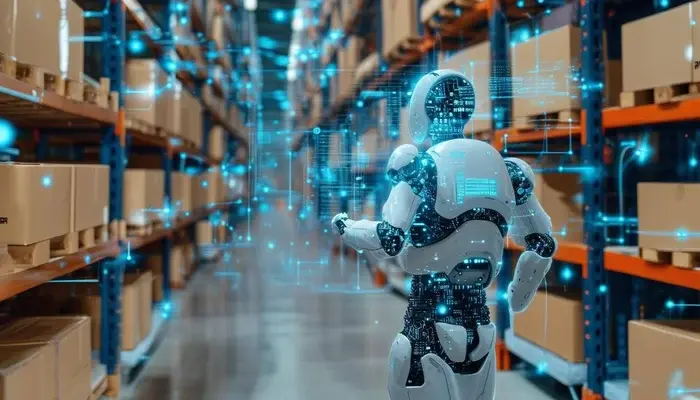
Robotic inventory systems can operate at scheduled intervals or during periods when normal warehouse activity is lower. Equipped with cameras, scanners, or other sensors, these systems can collect information about products and storage locations. When integrated with inventory software, the resulting data can help warehouse teams identify discrepancies earlier. This creates a more proactive approach to inventory management instead of relying exclusively on periodic manual checks.
The Importance of Data and Connectivity
A smart warehouse depends on more than physical automation. Sensors, cloud platforms, warehouse management systems, enterprise software, and robotic control systems need to exchange information accurately. Connectivity allows managers to understand where inventory is located, how robots are performing, where bottlenecks are developing, and whether equipment requires attention.
Data can also support continuous improvement. If warehouse managers discover that robots consistently spend excessive time traveling between particular locations, they can analyze the workflow and modify storage arrangements or task allocation. Over time, these small improvements can contribute to greater efficiency. Tech Hopes highlights this shift from isolated automation toward connected warehouse ecosystems where operational data becomes an important resource.
Challenges Businesses Need to Consider
Despite its potential, warehouse robotics involves several challenges. Initial costs can be significant, particularly for highly automated facilities that require new infrastructure and software integration. Existing warehouses may also have layouts that were never designed for autonomous machines. Floor conditions, storage systems, network infrastructure, product characteristics, and employee workflows can all influence implementation.
Another challenge is maintaining systems over the long term. Robots require software updates, hardware maintenance, replacement components, monitoring, and technical support. Cybersecurity also becomes increasingly important as more warehouse equipment connects to business networks. Organizations need appropriate access controls, monitoring, backup procedures, and security policies to protect operational technology and data.
What the Future Holds for Warehouse Robotics
The future of warehouse robotics is likely to involve greater collaboration between humans, machines, and intelligent software. Robots are becoming more adaptable, while artificial intelligence is improving their ability to interpret environments and respond to changing requirements. Instead of operating as isolated machines, future robotic systems will increasingly communicate with inventory platforms, order-management software, transportation systems, and other warehouse equipment.
Another important development is the growing accessibility of automation. Robotics was once primarily associated with large companies that could afford highly customized facilities. More modular robotic solutions are making automation relevant to a wider range of businesses. Companies may increasingly automate specific bottlenecks first and expand their robotic capabilities as operational needs and budgets evolve. This gradual approach can make automation more manageable while allowing organizations to measure results at each stage.
Tech Hopes provides a useful perspective on this broader technological transition because warehouse robotics is part of a much larger movement toward connected and intelligent business operations. The technology is evolving quickly, but successful adoption still depends on practical planning, employee involvement, data quality, and clear business objectives.
Conclusion
Robotics is reshaping warehousing by changing how products are stored, moved, picked, packed, sorted, and monitored. Autonomous mobile robots, robotic arms, automated storage systems, and intelligent software can help businesses respond to higher order volumes while improving consistency and operational visibility. At the same time, robotics introduces new requirements involving investment, maintenance, cybersecurity, employee training, and workplace safety.